

How Much Does the Average Hearing Aid Cost in Australia?
The average price for a pair of hearing aids in Australia ranges from $3,000 for basic models, up to $7,900+ for premium models with advanced sound processing features.
That’s a big difference between the cheapest model and the most expensive, and even models with the lowest costs are still a significant investment.
At Harmony Hearing, we believe it’s essential for everyone to get a complete understanding of how hearing aid prices are determined to avoid misinformation, so you can receive a hearing aid that offers the most value, without breaking the bank in the process.

2026 Hearing Aid Pricing Guide
| Technology Tier | Example Models | Recommended Pricing (per pair) |
| Premium AI Sound Processing |
|
$7,990 |
| Advanced+ Technology |
|
$6,990 |
| Advanced Technology |
|
$5,990 |
| Upper Midrange Technology |
|
$4,990 |
| Basic Rechargeable | Selected entry rechargeable models | $3,990 |
Fully or partially subsidised hearing aid options are available for eligible pensioners and concession card holders under the Australian Government Hearing Services Program (HSP).
If you are eligible for the HSP, you could save up to $3,500 on the price of your hearing aid. The amount of subsidy will depend on your choice of hearing aid and your specific circumstances.
As independent audiologists, Harmony Hearing can recommend hearing aid models that meet your listening needs and budget. And since we are not affiliated with any one hearing aid brand, our recommendations are unbiased and wholly focused on helping you hear better.
What’s Included in the Cost of Hearing Aids?
Hearing aid devices cannot be used straight out of the box and must be configured by a professional audiologist to ensure it is optimised for each individual’s hearing profile.
For this reason, a hearing aid purchase is usually bundled with complementary services like a hearing test and fitting session.
When you purchase a hearing aid with Harmony Hearing, you will also receive:
- Comprehensive Diagnostic Hearing Assessment
- Speech-in-Noise Evaluation
- Real Ear Measurement (REM) Verification
- Hearing Aid Programming & Fine Tuning
- Real-World Hearing Demonstrations
- Follow-Up Optimisation Appointments
- Bluetooth & App Setup Assistance
- Remote Care Support (compatible models)
- Personalised Independent Advice
Factors That Impact Hearing Aid Prices
1. Brand
As you’re making a significant investment in your hearing ability and overall well-being, it’s important to choose a hearing aid manufactured brand with a global reputation, such as:
At Harmony Hearing, we source the latest hearing aids from these brands and manufacturers, many of them part of the GN Hearing Group.
Hearing aids from international brands are typically priced higher than no-name or white-label models. You're not just paying for a brand name - it also means buying tech with latest hearing advancements, proven reliability, and access to ongoing support from both the supplier and the audiology clinic.
2. Technology
Modern hearing aids offer new tech features that can cater to different levels of hearing loss. At Harmony Hearing, the hearing aids we sell can now be loosely classified into tiers:
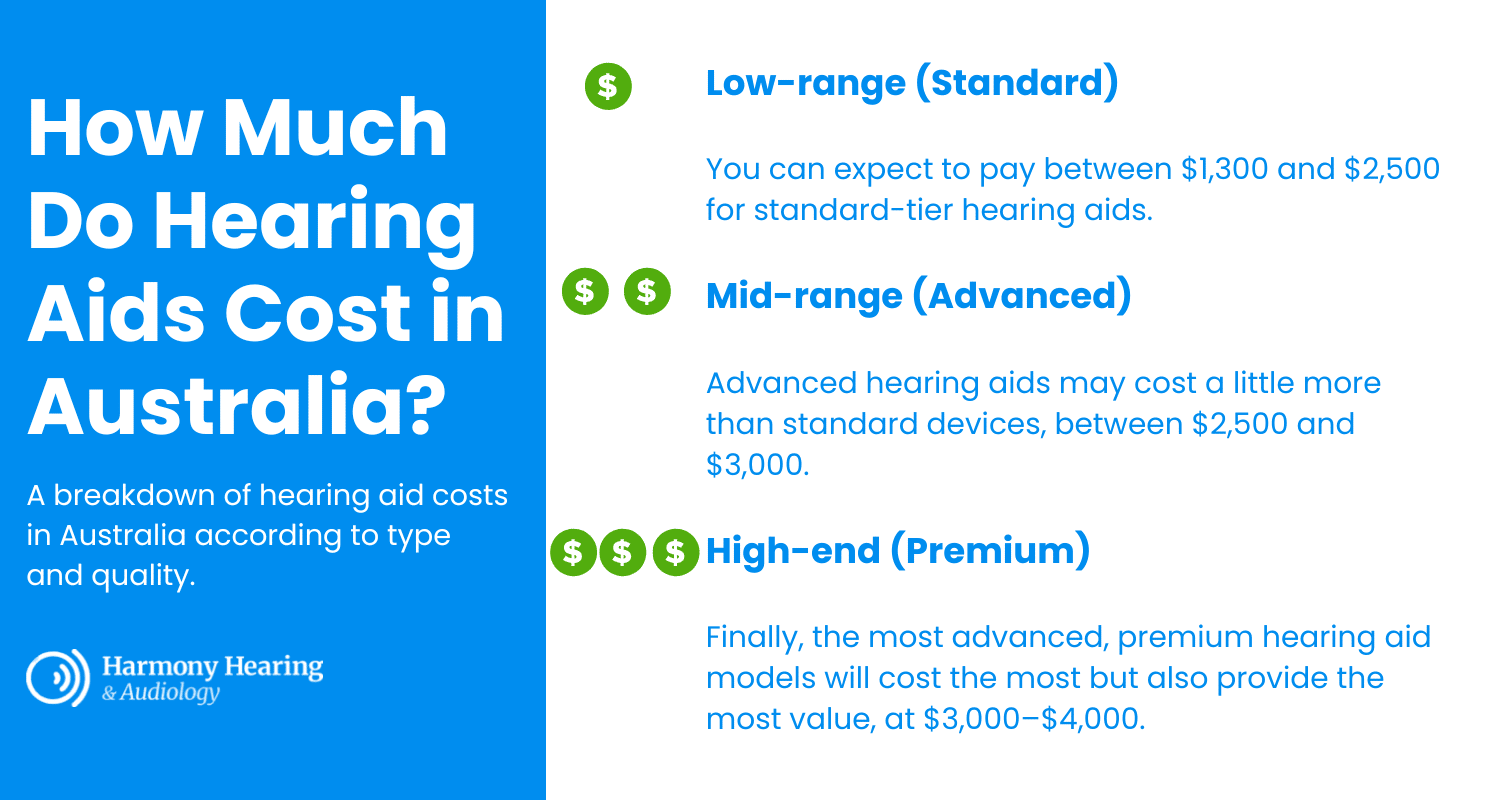
Low-range (Standard): You can expect to pay between $1,300 and $2,500 for standard-tier or entry level hearing aids that have general capabilities for mild to moderate hearing loss.
Mid-range (Advanced): Advanced hearing aids will cost more than standard devices, between $2,500 and $3,000 and come with additional features like noise reduction.
High-end (Premium): The most advanced hearing aid models will cost the most at $3,000-$4,000, but will offer the most in terms of the latest tech - from waterproof capabilities, remote control, and increased bandwidth.
The different tiers feature different improvements and levels of technological features such as:
- Noise reduction: Noise reduction settings can reduce wind noise levels and adjust for meetings, making it easier to pick up speech.
- Directional microphones: These allow users to pick up sounds in a chosen direction, improving speech understanding in noisy environments.
- Remote controls: For easy access, remote control compatibility allows users to adjust settings like noise reduction, volume, frequency, etc.
- Bandwidth size: Higher frequency bandwidth enables you to access higher frequency speech cues (or harmonics), which, in competing noise environments, provides further separation of the speech from the noise, reducing listening effort and improving sound localisation.
3. Type of Receiver
As the various types of hearing aid designs utilise different technologies due to their size, sound processes, and power sources, they also differ in price.
BTE (Behind-The-Ear): BTE hearing aids are used for mild to moderate hearing loss. BTE devices are made of a case worn behind the ear, connected to an earmold for the outer ear, which transmits the sound. BTE models are usually one of the most affordable types of hearing aids.
RIC (Receiver-in-Canal): RIC hearing aids are used for mild to severe hearing loss. Since the receiver goes directly into the ear canal instead of the housing, RIC models are smaller than BTE hearing aids. These models are often called ‘Bluetooth hearing aids’ or ‘receiver-in-the-ear (RITE) hearing aids.
ITE (In-The-Ear): ITE hearing aids are placed inside the outer ear. They are suitable for mild to severe hearing loss. As a general rule, ITE models are more expensive than BTE.
CIC (Completely-in-Canal): CIC hearing aids are suitable for mild to moderate hearing loss. Smaller and more compact, CIC devices fit completely in the ear canal and are generally custom-fitted, making them more expensive.
IIC (Invisible-in-the-Canal): IIC hearing aids are entirely hidden past the second bend of the ear canal. Known as invisible hearing aids, IIC are the smallest and most discreet hearing aids, suitable for mild to moderately severe hearing loss. IIC devices are often most expensive and are custom-moulded to the ear canal.

4. Battery Type
Your hearing aid will use one of two battery types: disposable or rechargeable lithium-ion. The latter is becoming more exceedingly common in newer models.
Rechargeable lithium-ion batteries may add an extra $399-$499 to hearing aid prices. However, in the long-term, this means you won’t need to pay for disposable batteries throughout the years you will use your hearing aid.
5. Additional Features and Accessories
With a huge number of hearing aid models to choose from, you’ll notice that some offer additional features that others don’t, such as:
- Bluetooth and smartphone streaming
- Motion sensors and tap control
- Compatible apps, remotes, and accessories
- Tele-audiology and remote servicing
- Complementary accessories
- Water, sweat and dust proofing
Here’s where you get to really personalise your hearing aid experience. Though additional features may inflate the price of your hearing aid, it’s good practice to write up a list of features you want and those you don’t so you can find the most suitable hearing aid for the best price. More features is not inherently better, it's about finding a hearing aid that addresses your specific requirements. A diagnostic hearing test is the first step in getting a hearing aid that is personalised to your needs and forms the basis of which hearing aids and features are going to be most suitable in treating your hearing condition.
6. Hearing Aid Schemes and Plans
Under the Government’s Hearing Services Program, government and NDIS rebates may be available for Pension and DVA Veteran cardholders and NDIS participants.
Depending on your health insurance provider, some policies with specific extras may offer partial coverage for hearing aids.
At Harmony Hearing, we believe hearing aids should be accessible to all who need hearing support. We always encourage our clients to investigate whether they are eligible for government funding, and we offer interest-free payment plans with Humm Finance for up to 24 months.
7. Maintenance, Service, and Experience
Just like a car - your hearing aid will perform better and last longer when serviced, maintained, and properly fitted by an audiologist. The average lifespan of a hearing aid is ~10 years, but after 8 years, it becomes increasingly difficult to repair devices if there's been inadequate maintenance or misuse.
Additionally, buying your hearing aid yourself without first consulting an audiologist can result in owning the wrong model and wasting money instead of saving it. While price is important, you’re not just buying a product, but also entering into a service relationship with your audiologist. Make sure your hearing aid provider can offer you the aftercare, maintenance, and support that you need to make the purchase a worthwhile investment.
Tips for Buying Hearing Aids In 2026
Hearing aid prices can vary greatly depending on the provider. With so many options on the market in 2026, buyers need to take the time to research different offerings to avoid overpaying for a hearing aid, or worse, purchasing a hearing aid that does not meet their needs. Be wary of are online-only suppliers with low prices but little to no after-sales support.
There are also third-party suppliers that market hearing aids at significantly discounted prices. Be wary of these options, as they tend to sell the hearing aid to customers, and then refer them to an affiliated hearing clinic that provides basic or substandard support for the fitting or adjustment of the hearing aid. Needless to say, it’s not ideal to have no control over who administers your hearing treatment, which is why it’s always advisable to choose a hearing aid provider that can also deliver comprehensive after-sales support.
Here are some things to consider and find out before choosing to purchase from a hearing aid provider:
- Does the hearing aid come with a warranty, and if so, how long does it go for and what are the terms and conditions that apply?
- Will the hearing aid come with a service package?
- Who will handle the fitting and adjustment services for the hearing aid?
- Is there insurance covering any loss or damage to the hearing aid?
- The inclusion of batteries, domes, wax filters and other accessories
- How are hearing aid repairs handled, and how long do they take?
- Does the provider offer after-sales support for maintenance and troubleshooting?
- Are there any trial programs or satisfaction guarantees to ensure that you end up with the right hearing aid device?
- Are they an independent provider? Independent providers do not have connections or affiliations with certain brands allowing them to offer genuine advice - these are members of Independent Audiologists Australia - IAA.
What Are White Label Hearing Aids?
Private or white-labelled hearing aids are brand-name hearing aids rebranded for sale to hearing aid retailers under a special brand or label. White-label hearing aids are produced to make it difficult for the consumer to analyse them; you cannot tell which generation of technology you are being recommended or the level of technology you are receiving.
White-label hearing aids are often offered at extremely low prices that are matched by their inherent disadvantages:
- Cost-cutting, compromising quality and performance.
- Consumer confusion due to shared designs and identical models.
- Limited customisation may not meet hearing needs.
- Minimal customer support and warranty through third-party sellers.
- Price inconsistencies and difficulty comparing prices.
- Reduced technological capabilities.
- Limited product choices.
- Exaggerated marketing claims.

