
What’s the Difference Between Hearing Aids & Amplifiers?
March 11, 2025
When it comes to hearing loss, individuals are met with a range of different hearing devices to choose between – two of the most common types are hearing aids and hearing amplifiers.
Hearing aids and hearing amplifiers are devices that are both designed to combat and help with hearing loss. Both will invariably increase the volume of sound and audio, however, there are differences between the two -hearing aids optimise specific sounds, whereas hearing amplifiers simply amplify all surrounding sounds.
When choosing the right hearing device, an audiologist will work with you to determine which is best for your unique set of circumstances.
What are hearing aids?
A hearing aid is a small electronic device that makes surrounding sounds louder. There are various styles and types of hearing aids available, however, all hearing aids are made with a microphone, amplifier, and speaker built into the device The microphone receives and converts sound, the amplifier increases sound signals, and the speaker sends sound to the ear. In Australia, hearing aids are regulated as medical devices by the Therapeutic Goods Administration (TGA).
Who should use hearing aids?
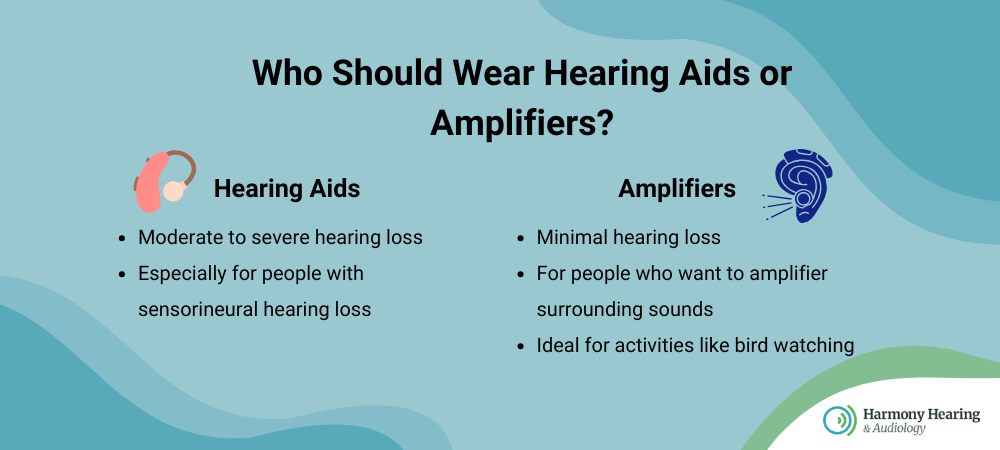
Hearing aids are designed for individuals diagnosed with moderate to severe hearing loss by an audiologist. Hearing aids are especially helpful for individuals with sensorineural hearing loss. Sensorineural hearing loss is caused by damaged hair cells or hearing nerves which can originate from bacteria, infection, aging, blood circulation issues, high blood pressure, strokes, and other conditions.
What are hearing amplifiers?
A hearing amplifier is a device worn in the ear to amplify surrounding sounds. A hearing amplifier has a microphone that picks up and processes sound and an amplifier to deliver the sound to the ear at a higher volume. In Australia, hearing amplifiers are not regulated as medical devices.
Who should use hearing amplifiers?
Hearing amplifiers are not made specifically for people with hearing loss. Hearing amplifiers can be used if you do have minimal hearing loss; individuals with mild to no hearing loss may benefit from hearing amplifiers to assist in hearing surrounding sounds in daily life. Hearing amplifiers are also used by people who want to hear certain sounds more clearly, like while bird watching or hunting.
What’s the difference between hearing aids and amplifiers?
While hearing aids and amplifiers both increase sound, there are significant differences between the two. The main difference is that hearing aids are designed for people with impaired hearing, while hearing amplifiers are intended for people with normal hearing to increase volume and clarity..
Hearing aid devices are prescribed by audiologists and are customised to the individual’s specific hearing loss needs. Hearing aids can can be made to fit the individual’s ear for comfort and aesthetic subtlety and are worn daily. H
Hearing amplifiers are designed for people who want to increase the volume of their surroundings, but are not made to aid hearing loss. Hearing amplifiers can help in boosting a person’s hearing ability in certain situations, but should not be worn all the time.
In Australia, hearing aids are viewed and treated as medical devices and are regulated by the Therapeutic Goods Administration (TGA). Hearing amplifiers, however, are not seen as medical devices and are not regulated.
Hearing aids vs hearing amplifiers – pros and cons
Pros of hearing aids
- Louder and clearer sounds: Hearing aids amplify sound as well as make it sound sharper.
- Technology: Some types of hearing aids have extra technological features like Bluetooth, tinnitus masking, Artificial Intelligence, and health tracking.
- Customisable: Hearing aids are customisable, making them more comfortable and feel secure to the ear.
- Cognition: When the brain doesn’t hear sounds, cognitive abilities can decrease. By delivering sound to the brain, hearing aids help reduce the risk of losing cognitive abilities.
- Noise filter: Most hearing aids have noise reduction features that can filter out some background noise, like crowded environments, to make it easier to focus on conversations.
Cons of hearing aids
- Adjustment period: Hearing aids often require an adjustment period to get used to sounds being louder and may involve multiple visits to the audiologist for fine-tuning.
- Battery dependent: Hearing aids either have disposable or rechargeable batteries, so it’s important to always be aware of the battery’s condition.
- Cost: Hearing aids can be expensive. However, under the Hearing Services Program in Australia, some hearing aids are completely or partially subsidised.
Pros of hearing amplifiers
- Amplify surrounding sounds: Hearing amplifiers make surrounding sounds louder, allowing individuals to appreciate sounds with more clarity.
- Can be used sparingly: As opposed to hearing aids which individuals are encouraged to wear consistently, hearing amplifiers can be used sparingly and when needed.
Cons of hearing amplifiers
- Designed for normal hearing: Hearing amplifiers are not designed for individuals with hearing loss and simply raising volume levels can result in further damage to hearing.
- No noise filter: Without a noise filter feature, hearing amplifiers cannot separate speech from noise – which can make it even harder to hear.
- Not customisable: Hearing amplifiers are for retail purchase only and cannot be tailored for individuals.
- Not subsidised: While hearing amplifiers’ retail price are generally more cost-effective than hearing aids, the Australian government does not subsidise costs.

Considerations when deciding between hearing aids and amplifiers
When deciding between hearing aids and amplifiers, it’s important to consider why you need hearing support in the first place. The best way to do this is by getting your hearing tested by a professional audiologist to understand how mild or severe your hearing loss is. For moderate to severe hearing loss, hearing aids are often the best option, whereas mild to no hearing loss may benefit from hearing amplifiers.
Other considerations when deciding between hearing aids and amplifiers, include:
- Volume or clarity: Hearing amplifiers increase volume, but do not make speech and sound clear. Hearing aids, however, increase the volume and clarity for surrounding sounds.
- Customisation: Hearing aids come in different styles, types, and colors, and offer a range of customisation options. Hearing amplifiers are usually a “one size fits all” design and do not offer customisation options.
- Cost: Some types of hearing aids can be completely or partially subsidised by the Hearing Services Program in Australia when prescribed. As hearing amplifiers are not regulated by the TGA or prescribed by an audiologist, the cost is not subsidised in Australia.
